A Disturbed Site in a Community Recovers and Moves Again Toward the Climax State in
Ecosystem Succession:
Disturbance and Recovery
Past Filip Tkaczyk
Ecosystem succession, also called "ecological succession," is the process through which a natural community of plants and animals changes after a disturbance. It is generally understood that ecological succession is a progressive movement towards the most stable community (also called a "climax community"). This kind of succession is the manner through which natural communities respond to disturbances and changes.
Ecosystem Succession is Based on Ecological Disturbance
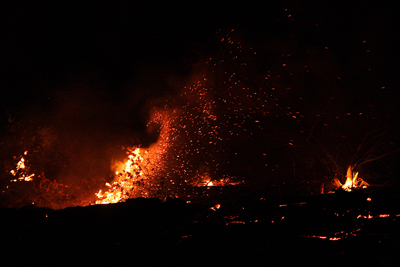
Disturbances to natural communities can be both elemental and homo-fabricated. Fires, floods, current of air storms, landslides, and avalanches are some examples of elemental ecological disturbances. While logging, mining, farming and urbanization are examples of human-fabricated disturbances.
Principal, Secondary and Cyclical Succession
Master ecosystem succession is when a community starting time forms in a newly created or exposed surface area such every bit a sand dune or bare stone surface, lava period, or a new lake created by flooding. In a sense, this is as if the community forms from a "clean slate" ecologically speaking.
Secondary succession is when a community was disturbed by human or elemental forces. This grade of succession tends to be much more than rapid as some of the vital elements such equally soil, nutrients and seeds are already present at the location at least to some extent. An example of this kind of succession is a forest recovering from a major forest burn or logging consequence.
Cyclical succession is when a community is changed by recurring events or changing interactions with species of plants or animals. An instance of this is the repeated fire cycles of the coastal chaparral ecosystem of California. Read more about information technology below.
Types of Succession
Here are a couple of examples of ecosystem succession in the western United States:
One example is the coastal chaparral of California. This type of ecosystem has a climax community that is composed of shrub-sized deciduous and evergreen vegetation. Fires are the major source of disturbance in this ecosystem. Fires come through in cycles of betwixt ten and fifteen years or sometimes longer. The plants and animals here must be adapted to long periods of dryness and mild, winter fourth dimension atmospheric precipitation. When fires occur, the plant life can recover relatively speedily and render to similar climax community in less than several years.
Another type of ecosystem succession is represented by the old-growth coastal temperate rainforests of the Pacific Northwest. Hither the climax customs is a complex of tree species of various ages and sizes, but is dominated past behemothic, old Sitka spruce, western red cedar, coast Douglas-fir and western hemlock. This forest experiences some disturbances from windstorms, flooding and very infrequently, from fires. Plants and animals in this ecosystem must be adapted to frequent precipitation, absurd to cold temperatures and relatively brusk summers. When major, catastrophic fires occur hither, the climax species have a long-time to recover to pre-fire state and reach a climax community. Some of the forest giants such as Sitka spruce and western red cedar may take several hundred or more years to accomplish full old-growth stature. Too, the circuitous relationships these copse form with other organisms such as fungi, other plants and animals may also accept a very long time to be re-established.
Gratuitous Mini Survival Guide: "Thriving in the Outdoors"
In this ix-folio guide, you'll discover keys to starting a burn down, edifice a shelter, purifying water, finding food... and many more life-saving skills.
Go your Gratuitous re-create now by signing up to our list. Observe more.
Succession in Your Neighborhood
A final example of ecosystem succession is that of an abased lot in a large city. Let's take an abandoned lot in Seattle for example. At first, species such as mosses grow across the exposed physical. The seeds of dandelion, hairy-cat's ear, chickweed and unlike grasses species abound in the cracks of the concrete and on whatever exposed soils. With fourth dimension, they brand room for small-scale shrubs such as salmonberry and wild rose. Then pioneer copse, such as red alder take root. They fix nitrogen, and prepare the soil for other trees to move in eventually. In such an urban location, many not-native or even invasive species may occur on such a site. Himalayan blackberry may end upwards taking over and shading out most of the other plants on this lot.
Closing Thoughts
It is important to remember that succession is a process that is happening all around u.s.a. all the fourth dimension. It is the means through which the natural world recovers from disturbance, and it is a procedure vital to the survival of institute and creature communities around the world.
Every ecosystem has its own natural patterns of succession and disturbance.
What is the natural ecosystem succession pattern where you lot alive?
Additional Resources:
Ecological Succession - Education Portal
Further Resources:

About the Writer: Filip Tkaczyk is a periodic guest teacher at Alderleaf. He also wrote the field guideTracks & Sign of Reptiles & Amphibians. Learn more about Filip Tkaczyk.
Return from Ecosystem Succession back to Wilderness Articles
Knowledge is Ability - Abound Your Wilderness Skills! Get monthly updates on new wilderness skills articles, upcoming courses, and special opportunities. Join the free Alderleaf eNewsletter and as a bonus you'll get our mini survival guide:
Source: https://www.wildernesscollege.com/ecosystem-succession.html
0 Response to "A Disturbed Site in a Community Recovers and Moves Again Toward the Climax State in"
Post a Comment