Marx 200 a Review of Marxã¢â‚¬â„¢s Economics 200 Years After His Birth Scribd
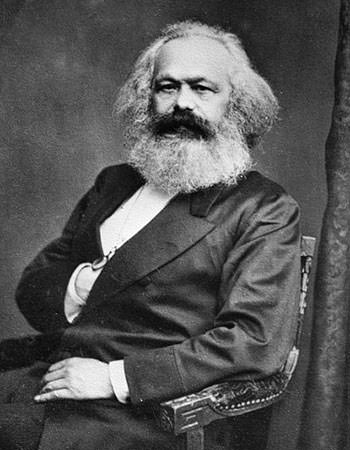
Karl Marx (1818 – 1883) was a German philosopher, economist, journalist and revolutionary who is one of the most influential figures in history due to the affect of his theories on subsequent intellectual, economic and political history. His most famous works include the Communist Manifesto, one of the world'southward about influential political manuscripts; and Das Kapital, the foundational theoretical text of communist philosophy, economics and politics. Amid the most influential theories of Marx are the theory of historical materialism based on class struggle; and the theory of breach of workers nether capitalist conditions. Marx is considered the father of modern sociology and his work in economics laid the foundation for agreement labor and its relation to capital letter. Know about the contributions of Karl Marx to economic science and sociology, also as his theories regarding commercialism and communism, through his 10 major accomplishments.
#one He put forward the theory of breach concerning the worker under commercialism
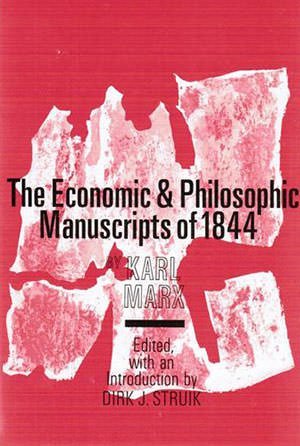
The notion of Alienation is cardinal to Marx'southward early writings. He first expressed his theory of breach in his Economic and Philosophic Manuscripts of 1844, which were unpublished in his lifetime. In the piece of work, Marx depicts the worker under capitalism equally suffering from four types of alienated labor. Showtime, from the product, which is determined by the capitalist class and over which he had no control; second, from the process of production, as he is controlled and told what to do and his labor is not voluntary but due to wage compulsion; third, from himself, as during piece of work he does non vest to himself but to another person and as he cannot develop the many sides of his personality but has to work equally a cog in a gigantic production apparatus; and fourth, from other workers, every bit he is pitted against them in a competition for "higher wages" and as he is part of a competitive labor-marketplace instead of a collective effort for the betterment of society. Marx's theory of alienation is one of the most influential concepts of his early work.
#2 He authored the famous Marxist theory of historical materialism
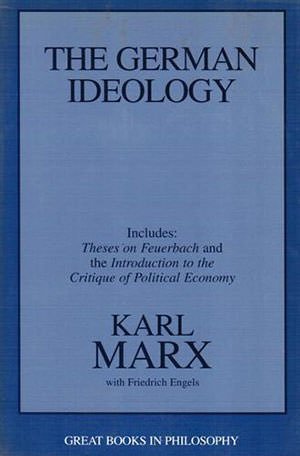
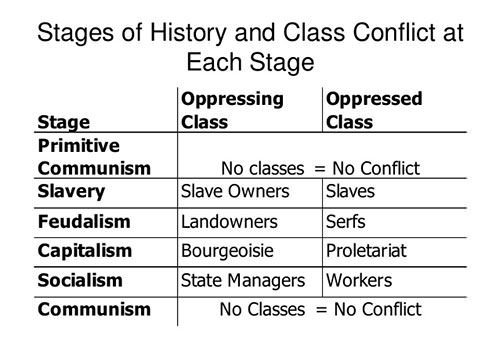
One of the most of import contributions of Karl Marx is his theory of historical materialism. It is stated most comprehensively in Die Deutsche Ideologie (The German Credo), a gear up of manuscripts co-authored by Marx and Friedrich Engels in 1846. Marx'southward theory of history sees human society as being fundamentally adamant at any given time by its cloth conditions, or the relationships which people accept with each other for producing and reproducing the ways of human existence. Marx identified six successive stages of the development of these cloth conditions in Western Europe: primitive communism; slave society; feudalism; capitalism; socialism; and communism. He thoroughly analyzed capitalism as information technology was the phase he lived in and he predicted that it would eventually be replaced past start socialism and so communism. Marx'southward theory of history is centered around the idea that forms of lodge rise and fall as they further, and so impede the development of human being productive power.
#3 His concept of class struggle was highly influential
Instead of conceiving order as being based on consensus, Karl Marx established a disharmonize model of social systems. Course struggle is tension which exists in gild due to competing socioeconomic interests and desires between people of different classes. Marx believed that grade struggle played the pivotal function in the history of class-based hierarchical systems such as capitalism. He identified capitalist society as containing ii main social groups: the Labor (the proletariat or workers), who earn their livelihood by selling their labor power and have footling pick merely to work for the capitalists; and the Capital letter (the bourgeoisie or capitalists), who get their income from the surplus value they advisable from the labor who create wealth. The income of the capitalists is thus dependent on their exploitation of the workers. Class struggle is key to Marx's theory of history and has had an enormous influence on sociology and study of human culture.
#4 Karl Marx co-authored the Communist Manifesto
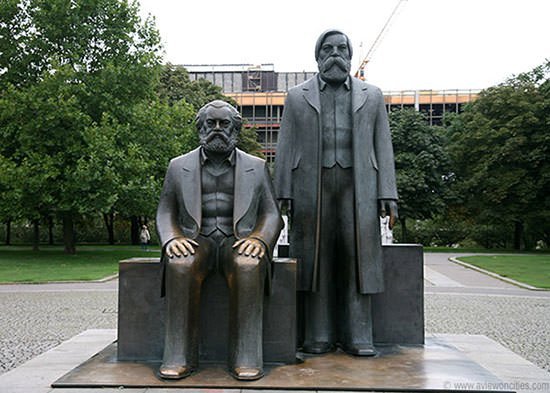
In 1846, Karl Marx and his shut friend Friedrich Engels established a small political circle in Brussels known as the Communist Respective Committee. The League of the Just was a socialist grouping which had been founded by German émigrés in Paris in 1836. In June 1847, the League of the But merged with the Communist Corresponding Commission to plant an international political party called Communist League, which remained in beingness till 1852. Marx and Engels jointly wrote the Manifesto of the Communist League, which was first published on 21 Feb 1848. The Communist Manifesto is divided into a preamble and four sections. The preamble urges the Communists to openly publish their views and aims; the kickoff section contains Marx's materialist conception of history; the second department expresses the volition of the party to defend the common interests of the world's working class; the third department distinguishes communism from other socialist doctrines prevalent at the fourth dimension; and the last section discusses the communist position on struggles in diverse countries in the mid-nineteenth century.
#five Communist Manifesto is considered one of the almost influential political manuscripts ever
The Communist Manifesto had an influence, restricted to Germany, during the Europe-wide revolutions of 1848. For 40 years, from 1870s to 1910s, due to the rise of social-democratic parties, hundreds of editions of the manifesto in xxx languages were published across Europe and in parts of the world. The primary region of its influence was the "central belt of Europe", from Russia in the east to French republic in the westward. Following the successful Russian Revolution, the world'south showtime socialist land was founded explicitly forth Marxist lines and it was required for the political class to know the Communist Manifesto. The text gained in influence across the globe and entered political-science syllabuses in many universities. Even after the collapse of the Soviet Bloc in the 1990s, the manifesto remains widely read and many consider information technology as a valuable insight into the society in which we alive today also as an caption for today's world of recurrent wars and repeated economical crunch. The Communist Manifesto is considered as i of the world'due south nigh influential political manuscripts.
#vi He wrote the groundbreaking work Das Kapital
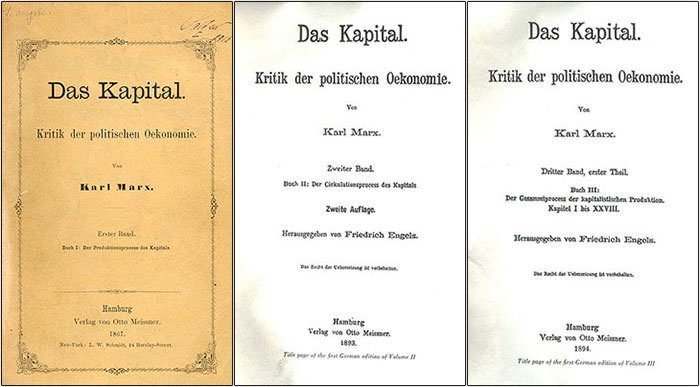
Das Kapital (Majuscule: Critique of Political Economy) is a three volume work by Karl Marx. The first volume was published in 1867; while the 2d (1885) and tertiary (1895) were published after his death due to the endeavour of his collaborator Friedrich Engels. The principle idea of the work is that the motivating force of capitalism is in the exploitation of labor, whose unpaid piece of work is the ultimate source of surplus value. According to Marx, it was not the pressure of population that drives the salaries of the worker to subsistence level (the minimum level to support oneself) but rather the beingness of a big regular army of unemployed, which is in accented interest of the capitalists and increases with accumulation of capital. According to Das Kapital, the backer system is doomed to collapse as the "capitalist form becomes unfit to rule, because it is incompetent to assure an being to its slave within his slavery." It is then replaced past a system where the working grade inherits economic and political power. Das Kapital is the foundational theoretical text of communist philosophy, economics and politics; and one of the almost influential works in history.
#7 He was a leading member of the Commencement International
In 1864, the International Workingmen's Clan (IWA) was founded in London. Too known as the Kickoff International, IWA had a considerable influence as a unifying forcefulness for labor in Europe during belatedly 19th century; and at its peak, it was reported to have around viii meg members. Marx was a primal member of IWA and drew up the fundamental documents of the organisation. The IWA played a role when the citizens of Paris rebelled against their regime and held the urban center from xviii March to 28 May 1871. During this fourth dimension the urban center was governed past a radical socialist and revolutionary government known every bit the Paris Commune. The District was ultimately suppressed by the French regular army. In response to this bloody suppression, Marx wrote one of his well-nigh famous pamphlets, The Civil State of war in French republic. In 1872, the IWA started to decline and split into two; a socialist wing nether Karl Marx and an anarchist faction led by Mikhail Bakunin.

#8 His work in economic science laid the foundation for understanding labor and its relation to uppercase
Karl Marx made several important contributions to economic science. According to Marx, 'economic science' cannot be separately from sociology, history etc; and in that location are no eternal economic laws every bit they change with the style of production. Thus to reduce economic problems to purely fabric was considered mystification by him; and his economic analysis is characterized by a sense of historical relativism. Amidst his well known theories is the labor theory of value (LTV) which argues that the economic value of a good or service is determined by the total amount of socially necessary labor required to produce it. Political economics based on the writings of Karl Marx is known as Marxian economics. Several of its concepts, like those related to majuscule aggregating and the business cycle, are used in capitalist systems. The work of Karl Marx in economic science influenced subsequent economical thought and laid the basis for much of the current understanding of labor and its relation to capital.
#9 Karl Marx is considered the founder of modern sociology
Social science is a major academic field of study which is concerned with order and the relationships amid individuals within a society. The master social sciences include economics, political science, demography and sociology. Sociology is the systematic study of guild and human social action. Along with Émile Durkheim and Max Weber, Karl Marx is considered 1 of the three master architects of modern social science. He is also regarded as the founder of modernistic sociology. In dissimilarity to previous philosophers, Marx offered theories that could often be tested with the scientific method. Key concepts of Marxist sociology include historical materialism, modes of production and the relation betwixt capital and labor. Information technology is primarily concerned, though not limited to, the way economic science define social roles and expectations. Marx'south notion of metabolic rift, which occurs due to ecological crisis tendencies under capitalis1000, is considered the predecessor to modern environmental sociology.
#x He was i of the most influential figures in history
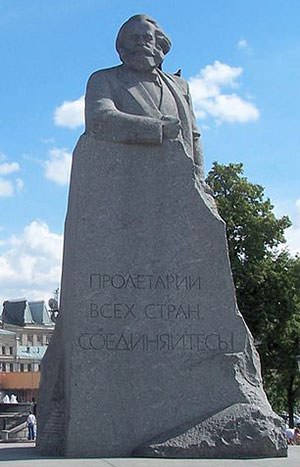
Karl Marx was one of the near influential figures of the 19th century. His piece of work influenced subsequent intellectual, economical and political history. Throughout the twentieth century, revolutions in dozens of countries labeled themselves 'Marxist', most notably the Russian Revolution, which led to the foundation of the world'southward offset socialist state, the Soviet Marriage. Major earth leaders including Vladimir Lenin, Mao Zedong and Fidel Castro cited Marx as an influence. However, the original ideas of Marx have often been modified and many movements accept non been true-blue to his works. Karl Marx also provided a revolutionary critique of nineteenth-century capitalism and many believe that his theories on the exploitative relationship betwixt backer employers and their employees remain valid till today. Fifty-fifty though he remains a controversial effigy, Karl Marx is withal regarded every bit i of the greatest thinkers in history.
Source: https://learnodo-newtonic.com/karl-marx-contribution
0 Response to "Marx 200 a Review of Marxã¢â‚¬â„¢s Economics 200 Years After His Birth Scribd"
Post a Comment